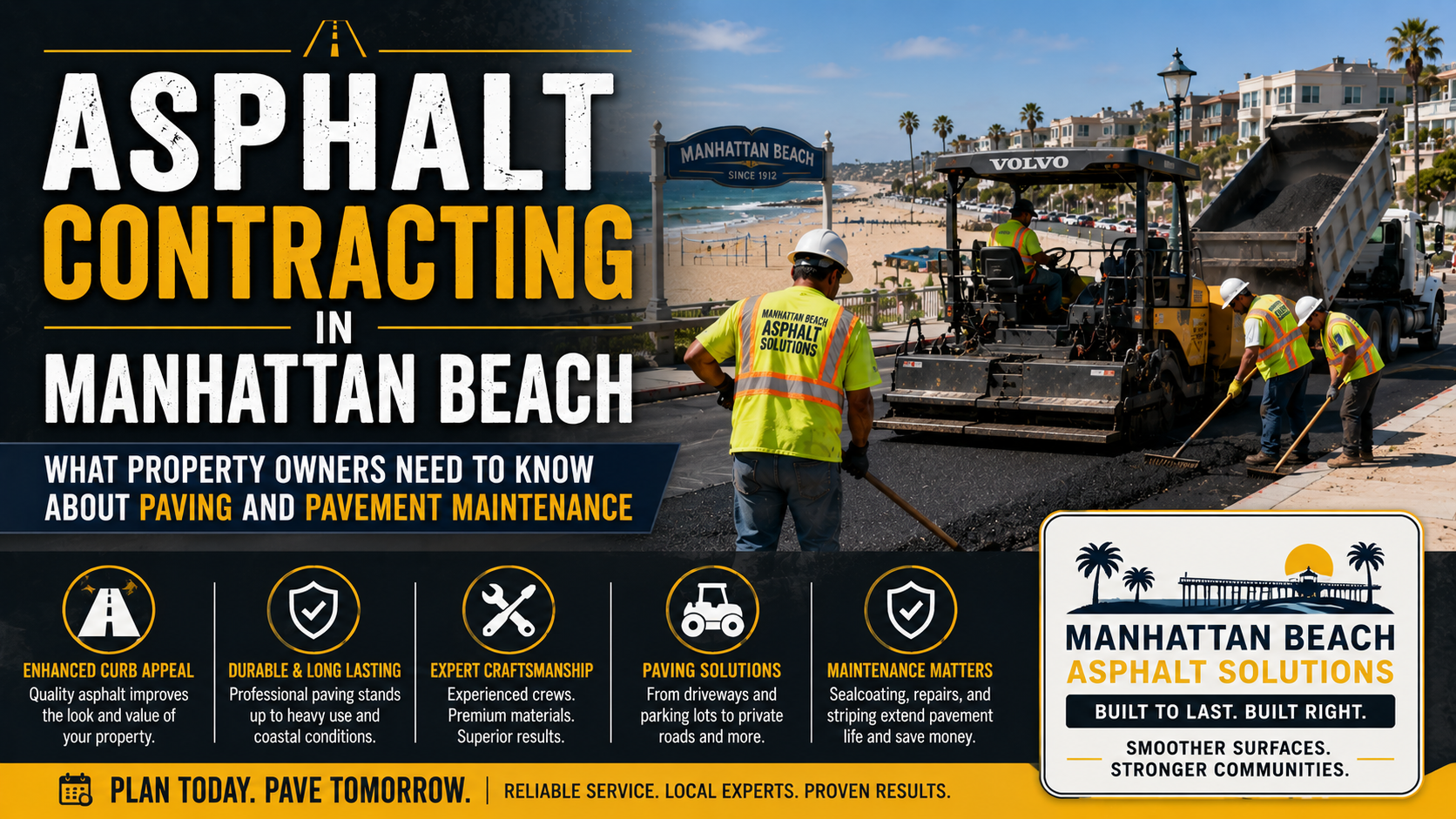
Manhattan Beach is one of Los Angeles County’s most sought-after coastal communities a city that takes pride in its well-maintained streets, beautiful residential neighborhoods, and vibrant commercial districts. Maintaining the quality of pavement surfaces throughout Manhattan Beach requires ongoing attention, skilled contractors, and an understanding of how coastal Southern California’s climate affects asphalt differently than inland environments.
From private residential driveways and alley surfaces to commercial parking lots and shared community paving in HOA-managed neighborhoods, Asphalt Contractor Manhattan Beach maintenance is a significant aspect of property management in Manhattan Beach. This guide explains how asphalt paving and maintenance works, what the common services involve, and why the coastal environment creates specific considerations for pavement longevity in this community.
Asphalt in the Coastal Southern California Environment
Manhattan Beach’s coastal location creates a distinctive set of environmental conditions that affect asphalt differently than the experience of inland Los Angeles communities.
Salt Air and Humidity: Proximity to the Pacific Ocean means Manhattan Beach pavement is regularly exposed to salt-laden air and elevated humidity. Salt aerosols, while not as directly damaging to asphalt as they are to metal surfaces, can contribute to the breakdown of surface sealants and accelerate oxidation at the pavement surface. Humidity also means that crack sealing and sealcoating must be scheduled during dry, appropriately warm periods to ensure proper adhesion and curing.
Moderate Temperatures: Manhattan Beach’s coastal marine layer keeps temperatures relatively moderate compared to inland communities, which actually benefits asphalt in one important way the extreme thermal stress that bakes and cracks asphalt in hotter inland areas is less severe here. However, the regular marine layer and morning fog still introduce moisture, and the transition between cool, damp mornings and warmer afternoons creates a modest but consistent thermal cycle that affects pavement over time.
UV Exposure: Despite the marine layer’s influence on temperature, Manhattan Beach receives substantial UV radiation, particularly during the late morning and afternoon when the marine layer burns off. UV oxidation of asphalt binders remains a primary driver of surface aging, causing the characteristic fading from black to gray and the development of surface brittleness that precedes cracking.
Vehicular Traffic Patterns: Manhattan Beach has a mix of light residential traffic, beachgoer and visitor parking near the strand and downtown, and commercial delivery traffic servicing the retail and restaurant district. This variety of traffic patterns means different pavement areas experience different rates of wear and require service approaches tailored to their specific use.
Residential Driveways and Alleys in Manhattan Beach
Manhattan Beach is a dense coastal community where many properties are served by rear alleys a characteristic of the beach city grid that is relatively uncommon in broader Los Angeles. These alleys serve as primary vehicle access points and are subject to significant use, including delivery vehicles, service trucks, and daily resident traffic.
Residential driveways and alleys in Manhattan Beach are typically paved with either asphalt or concrete. Asphalt offers advantages in this setting: it can accommodate the soil movement more common in coastal areas with variable moisture content, it is easier to repair and patch when localized damage occurs, and the initial installation is generally less expensive than concrete. Asphalt driveways and alleys can be expected to last 15 to 20 years with proper maintenance.
Common residential paving projects in Manhattan Beach include new driveway installation, driveway resurfacing or overlay, pothole and depression repair, edge repair and reinforcement, and full replacement of driveways or alley sections that have deteriorated beyond the point where maintenance is cost-effective.
For properties in HOA-managed communities or those with shared alley surfaces, paving work often requires coordination among multiple property owners and may involve municipal permissions. A qualified local asphalt contractor can navigate these requirements and coordinate the sequencing of work to minimize disruption.
Commercial Paving in Manhattan Beach
Manhattan Beach’s downtown commercial district and surrounding retail and restaurant areas rely on well-maintained parking and access surfaces to support the customer experience that drives local business. A deteriorating parking lot creates a poor first impression, poses slip-and-trip liability risks, and in severe cases can deter customers from visiting.
Commercial asphalt paving in Manhattan Beach encompasses parking lot installation and renovation, surface resurfacing to renew worn lots, crack sealing and pothole repair programs, sealcoating to extend surface life and restore appearance, drainage improvements to manage stormwater, and ADA compliance upgrades including accessible parking stalls, access aisles, curb ramps, and compliant signage.
California has stringent ADA requirements for commercial parking facilities, and the obligation to maintain accessible features is ongoing not just at the time of initial construction. Commercial property managers and business owners should include ADA compliance in their regular pavement assessment process.
Sealcoating: Essential Maintenance for Manhattan Beach Pavement
Sealcoating is one of the most impactful maintenance services available for asphalt surfaces. Applied as a liquid emulsion to existing asphalt, sealcoat creates a protective layer that addresses several of the primary drivers of asphalt deterioration in the Southern California coastal environment.
UV Protection: Sealcoating significantly reduces the rate of UV oxidation by providing a barrier between the asphalt surface and solar radiation. Studies have shown that sealcoating can reduce oxidation by up to 70 percent, dramatically extending the service life of the pavement surface.
Water Resistance: Sealcoat fills fine surface voids and cracks, reducing water infiltration into the pavement structure. This is particularly valuable in Manhattan Beach where coastal moisture and occasional heavy rainfall during the wet season can infiltrate unsealcoated surfaces.
Chemical Resistance: Vehicle fluids engine oil, transmission fluid, brake fluid, and fuel can soften and deteriorate asphalt binders. Sealcoating creates a chemically resistant surface that prevents these substances from penetrating the pavement.
Appearance: Freshly applied sealcoat restores the deep black color of asphalt, significantly improving the visual appearance of driveways, parking lots, and alley surfaces. In a community like Manhattan Beach, where property presentation matters, this aesthetic benefit is practically valuable.
In California’s mild climate, pavement professionals generally recommend applying the first sealcoat 12 to 24 months after new asphalt installation, allowing the pavement to fully cure and residual oils to evaporate before sealing. Subsequent sealcoat applications every two to three years maintain protection and appearance. Manhattan Beach properties with high sun exposure or heavier traffic may benefit from the shorter end of this interval.
Crack Sealing: The First Line of Defense
Among all the maintenance services available for asphalt pavement, crack sealing offers arguably the best return on investment. A crack in asphalt is an entry point for water, and water that enters the pavement structure causes damage far beyond the crack itself weakening the base, accelerating oxidation in adjacent areas, and setting the stage for pothole formation.
Crack sealing is the process of cleaning asphalt cracks removing debris, vegetation, and loose material and filling them with a hot-applied, flexible rubberized sealant that bonds to the crack edges and remains pliable as the pavement expands and contracts with temperature changes. The material is specifically formulated to accommodate pavement movement without losing adhesion or cracking itself.
In Manhattan Beach’s climate, crack sealing is most effectively performed during the dry season spring through fall when pavement surfaces are dry and ambient temperatures are within the range required for proper sealant application and adhesion. Sealant manufacturers typically specify a minimum pavement surface temperature of 40°F, which is easily achieved in Manhattan Beach’s moderate coastal climate.
Crack sealing is most effective when performed while cracks are still in the early stages of development before they have widened significantly or allowed water to reach the base layer. Once base failure has occurred, crack sealing alone is insufficient and more substantial repair is required. Regular inspections, ideally annually, allow property owners and managers to identify and seal cracks while they remain minor.
Pothole Repair and Pavement Restoration
Potholes are the visible result of a failure process that typically begins long before the surface collapses. Water infiltrates through unsealed cracks, weakening the base material and causing it to deform under traffic loads. Over time, the asphalt surface loses support from below and begins to crack further, eventually breaking into the characteristic pothole shape.
Potholes are repaired using one of several methods depending on their size, depth, and the condition of the surrounding pavement. Throw-and-roll patching filling the pothole with cold or hot mix asphalt and compacting it by driving over it is a temporary measure suitable for low-traffic areas or emergency situations. Semi-permanent patching involves more careful surface preparation before the patch material is placed and compacted, producing a longer-lasting result. Full-depth patching, in which the failed material is excavated to the base and a complete pavement section is rebuilt, is the appropriate approach for large or structurally compromised areas.
For Manhattan Beach properties, potholes that are not addressed promptly become larger and more expensive to repair as traffic continues to stress the unsupported edges. They also create liability exposure for property owners when vehicle or pedestrian damage results from pavement defects.
A comprehensive pavement management approach combining regular inspections, proactive crack sealing, scheduled sealcoating, and prompt pothole repair is the most cost-effective way to maximize the service life of asphalt surfaces in Manhattan Beach. The cost of disciplined maintenance is consistently far lower than the cost of deferred repair and eventual full replacement.
Choosing the Right Asphalt Contractor for Manhattan Beach
Asphalt work in Manhattan Beach requires contractors who understand not only the technical aspects of paving but also the specific requirements of the coastal Los Angeles environment and the expectations of property owners in a community that values quality and presentation.
In California, asphalt paving contractors are required to hold a valid C-12 license (Earthwork and Paving) issued by the California Contractors State License Board. Verifying that any contractor holds a current license in this classification and carries appropriate insurance coverage is a fundamental first step for any property owner.
Experience with projects similar in type and scale to the work needed is another important consideration. Residential driveway work, commercial parking lot paving, and alley resurfacing each have their own requirements and challenges. A contractor with a track record of successful projects in Manhattan Beach and the surrounding South Bay communities will be familiar with local permitting processes, material suppliers, and the specific conditions that affect pavement performance in this environment.
References and verifiable reviews from past clients, a clear and detailed written scope of work and project proposal, and transparency about materials and installation methods are hallmarks of a professional asphalt contractor. For Manhattan Beach property owners investing in pavement work, taking the time to engage with qualified, reputable contractors ensures that the investment delivers the durability and quality the community deserves.